Commercial licenses for open AI models: Krea 2, Qwen Image Edit and Wan explained
Can you sell what you make with Krea 2, Qwen-Image-Edit 2511, Wan 2.2 and Wan Animate 2? A plain reading of Apache 2.0 and the Krea 2 Community License.
“Can I sell this?” is the first question people ask after their first good render, and it deserves a straight answer. For most freelancers and small businesses, the answer for these four models is yes. But one of them has a condition that matters, and none of the licenses protect you from using someone’s face.
This isn’t legal advice. I’m summarising the license texts as published on the official model pages in October 2026. Licenses change. Read the current version yourself before you build a business on it, and talk to a lawyer if real money is involved.
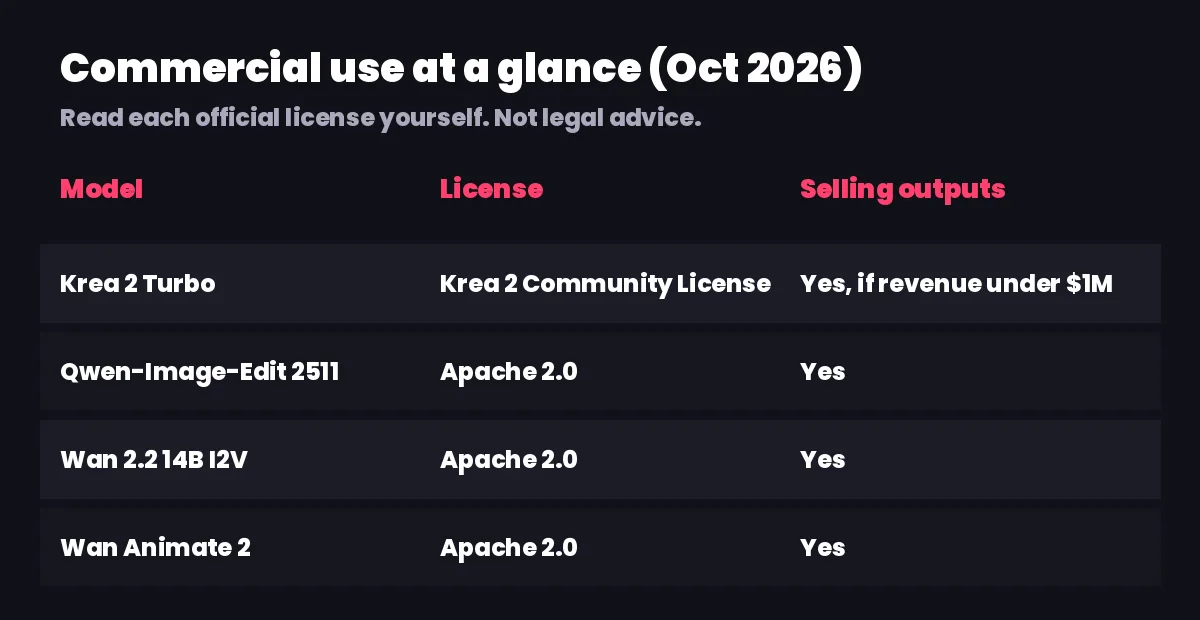
Which license does each model use?
I checked each official page:
| Model | License | Where to read it |
|---|---|---|
| Krea 2 Turbo | Krea 2 Community License | Krea 2 Turbo on Hugging Face |
| Qwen-Image-Edit 2511 | Apache 2.0 | Qwen-Image-Edit-2511 on Hugging Face |
| Wan 2.2 14B I2V | Apache 2.0 | Wan2.2-I2V-A14B on Hugging Face |
| Wan Animate 2 | Apache 2.0 | Wan2.2-Animate-2-14B on Hugging Face |
Note that the Krea 2 Turbo page is gated. You need a Hugging Face account and have to accept the terms before downloading, which is itself a sign that you’re agreeing to a contract, not just grabbing a file.
What does Apache 2.0 let you do?
Apache 2.0 is one of the most permissive licenses around. In plain terms, you can use the model commercially, modify it, and redistribute it. The conditions mostly kick in when you redistribute the model itself: include a copy of the license, keep the copyright and notice files, and mark files you changed. It also includes a patent grant from contributors.
What you generate is a separate question, and the Wan team answers it directly. The Wan 2.2 model card says the models are licensed under Apache 2.0 and that they “claim no rights over” your generated content. The same card asks that you don’t use the models to share illegal or harmful content, spread misinformation, or target vulnerable groups. Wan Animate 2’s model card also lists Apache 2.0, and the Qwen-Image-Edit 2511 card says “Qwen-Image is licensed under Apache 2.0.”
For someone making images and videos, that means:
- Selling outputs is allowed.
- Client work is allowed.
- No revenue cap, no royalty.
What’s different about the Krea 2 Community License?
This is the one to actually read. The version I read is “Krea 2 Community License Agreement v.1”, dated June 22, 2026. It covers both Krea 2 Raw and Krea 2 Turbo. The main points:
Commercial use has a revenue cap. Section 2.3 allows commercial use only if you, including all affiliated entities, have total company-wide annual revenue under $1,000,000, calculated over the trailing twelve months and counting all revenue from all sources. At or above that, you need an enterprise license from Krea first. If you cross the line while using it, you have to stop commercial use immediately and contact Krea.
“Commercial use” is defined broadly. It covers any use of the model, derivatives or outputs connected to a business, including generating revenue directly or indirectly. A sponsored post counts.
You own your outputs. Section 5.3 says you own the outputs you generate, subject to following the agreement, and Krea claims no ownership. You’re also fully responsible for them.
AI disclosure is part of the deal. Section 4.3 says that where law, regulation or platform policy requires it, you must clearly disclose that outputs were AI-generated. So skipping TikTok’s AI label isn’t only a platform problem.
Some terms are aimed at people deploying the model. Section 4.2 requires reasonable content filters, and Section 3 has rules for redistributing the model or derivatives (keeping “Krea” at the start of a derived model’s name and including a notice file). If you just run it locally to make images, these matter less, but read them if you’re building an app or service around it.
Krea can end it. Section 9.2 lets Krea terminate the license for any reason with 30 days’ notice. That’s a real difference from Apache 2.0, and it’s why I wouldn’t build a product that depends only on Krea 2 without a backup plan.
There’s also an Acceptable Use Policy that’s part of the agreement by reference.
What counts toward the $1M revenue limit?
The text says company-wide revenue from all sources, not just the money you make from AI images. A few illustrative cases:
- A solo freelancer billing well under $1M a year: commercial use is allowed.
- A small agency whose total revenue is over $1M, even if AI work is a tiny slice: needs an enterprise license.
- A side project inside a larger company: affiliated entities count, so the parent company’s revenue counts too.
The awkward case is client work. If you’re a small freelancer making images for a big brand, who is “you”? The agreement says that if you’re entering it on behalf of an employer or another entity, “you” also means that entity. Whether a contractor relationship falls under that is exactly the kind of question I’d send to Krea (enterprise inquiries go to [email protected], per the license) or a lawyer rather than guess.
Does a commercial license mean the content is safe to use?
No, and this is the part people miss. A model license covers your right to use the model. It says nothing about other people’s rights in what you put into a prompt or a reference image.
The Krea license makes this explicit in the other direction. Under Section 8, you indemnify Krea against claims that your outputs violate someone’s intellectual property, privacy or publicity rights. Translation: if you make an ad with a celebrity lookalike, that’s on you, not Krea.
So the boring rules still apply:
- Fictional characters only. No real people’s likeness without clear permission.
- Your own footage. Driving videos, voices and music you own or have licensed. Not someone’s TikTok.
- Fictional or your own brands, unless a client hired you and approved the ad.
- Label AI content where platforms ask.
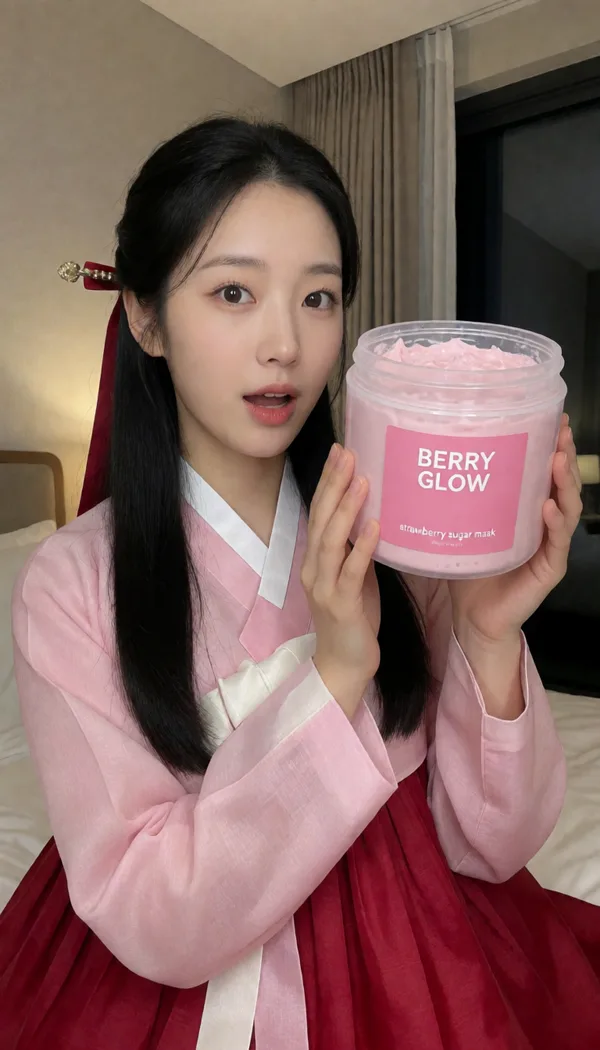
Every person and brand in the AI Character Kit samples, including Aanya, Seo-yeon, Mia and BERRY GLOW, is fictional and AI-generated for exactly this reason.
What about the LoRAs and text encoders?
A workflow uses more than the main model. The kit also loads speed LoRAs (like the Qwen Lightning and LightX2V LoRAs), text encoders and VAEs. Each of those has its own model page and license. I haven’t covered them here, so check each one the same way before commercial use.
How do you check a license yourself?
It takes ten minutes and you only need to do it once per model version:
- Open the official model page, not a reupload.
- Find the license tag and the full license file or section.
- Note the version and date.
- Save a copy (a PDF or screenshot) with the date you downloaded the model.
- Write down how each condition applies to you: revenue, client work, redistribution.
- Recheck when you update to a new model version.
So, can you sell what you make?
For most solo creators and small businesses: yes, with all four. Apache 2.0 models are the easy case. Krea 2 is fine under $1M in total revenue, with disclosure and the other conditions above. Above that, talk to Krea first.
The AI Character Kit ships with a license summary in its guide and download links that all point to the official Comfy-Org pages on Hugging Face, so you always know where a model came from before using it for paid work.